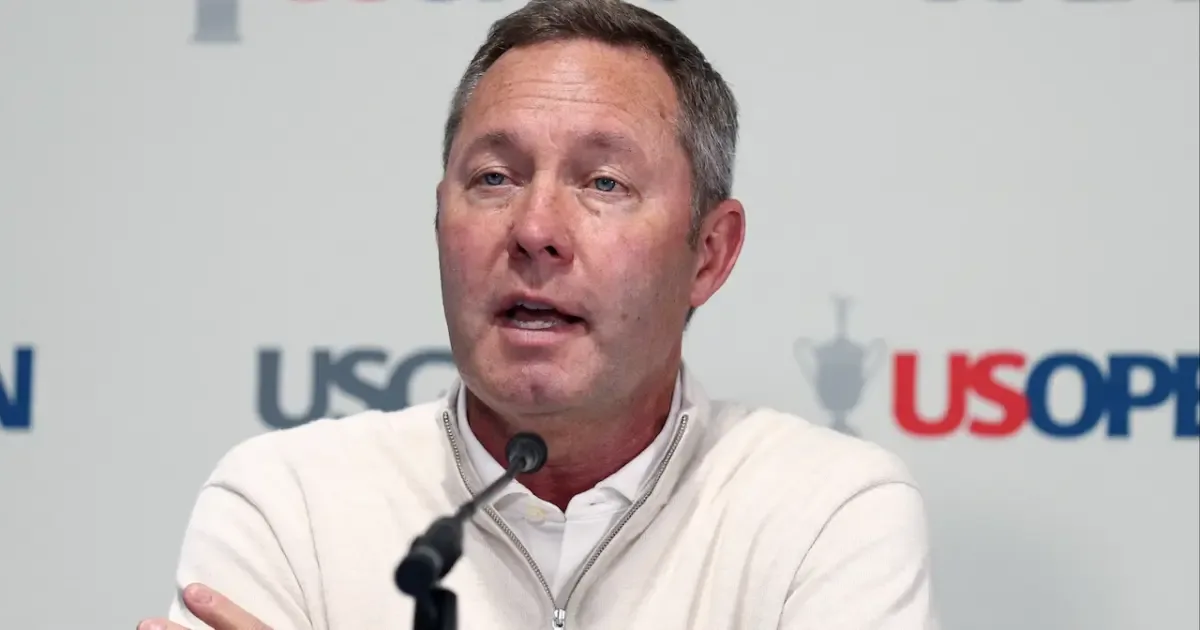
USGA CEO Mike Whan has firmly stated that the organization is not trying to compete with LIV Golf, despite the U.S. Open announcing a significant purse increase. “We’re not chasing,” Whan declared, addressing speculation that the $22.5 million prize money for the 2024 championship was a direct response to the Saudi-backed league’s lucrative offerings. The statement came during a press conference where Whan was asked directly about comparisons between the U.S. Open’s enhanced purse and the financial structures of LIV Golf events.
Whan emphasized that the U.S. Open’s focus remains on its own rich history, established brand, and the players who compete. He asserted that the championship does not need to follow the financial strategies of other tours, highlighting its unique value and legacy. “We know who we are, and we’re comfortable with that,” Whan said, reinforcing the USGA’s independent approach. His remarks are significant because they come at a time when the golf world is deeply divided over the influx of money from LIV Golf and the resulting realignment of professional golf.
This stance comes amid ongoing discussions about whether traditional golf tournaments need to raise prize money to retain top talent from defecting to LIV Golf. Whan’s clear message is that the U.S. Open operates on its own terms, prioritizing its own path rather than reacting to competitors. The U.S. Open, with its 128-year history as one of golf’s most demanding tests, has always emphasized the prestige of its championship over financial inducements. Whan’s comments suggest that philosophy will continue even as other tournaments escalate their payouts.
U.S. Open Announces Record $22.5 Million Purse
The 2024 U.S. Open, one of golf’s four major championships, will feature a total prize fund of $22.5 million. This represents a notable increase from previous years, with the 2023 purse at $20 million and the 2022 purse at $17.5 million, continuing a trend of rising payouts in professional golf. The five-year trend shows a steady climb: in 2019, the purse was $12.5 million; by 2020, it had risen to $12.5 million (though pandemic-affected); in 2021, it was $12.5 million; and then the jump to $17.5 million in 2022 marked a significant inflection point. The 2024 increase to $22.5 million is the largest single-year boost in the championship’s history, reflecting both inflation and the changed economic environment of professional golf.
While the exact breakdown for the winner’s share is pending, it is expected to be around $4 million. The increased purse benefits all players who make the cut, with prize money extending deeper into the leaderboard. In 2023, the winner received $3.6 million from a $20 million purse; a similar proportional increase would place the 2024 winner’s share near $4 million. The USGA also allocates additional funds for exemptions, travel subsidies for amateur participants, and other operational aspects of the championship. The purse is funded primarily through broadcast rights, ticket sales, corporate sponsorships, and hospitality revenues that the USGA generates from the U.S. Open and its other championships.
Other major championships have also seen purse increases. The Masters offered $18 million in 2023, the PGA Championship raised its purse to $17.5 million, and the Open Championship offered $16.5 million. However, the U.S. Open’s $22.5 million purse is the largest in its history and surpasses all other majors in total prize money. This positions the U.S. Open as the most lucrative major in terms of total payout, though some LIV Golf individual events offer comparable winner shares. The purse increase of $2.5 million from 2023 to 2024 was decided by the USGA Executive Committee, which reviews financial projections and Championship revenues annually.
This substantial increase led some observers to draw parallels with LIV Golf, whose events typically offer $25 million purses, including significant amounts for individual competition and team events. LIV Golf also offers substantial guaranteed contracts and signing bonuses, altering the financial landscape of the sport. The difference is that LIV’s purses are backed by the Saudi Public Investment Fund, while the U.S. Open’s prize money comes from the USGA’s own revenues, which are reinvested into governing the game and supporting golf development. The USGA is a nonprofit organization with a mission to promote and conserve the game of golf; its financial decisions are driven by its ability to generate revenue from its championships, not by a bottomless budget.
Mike Whan: ‘We’re Not Chasing Anyone’
USGA CEO Mike Whan directly addressed the comparisons, stating that the U.S. Open’s purse increase is driven by the championship’s own development and not by LIV Golf. “We’re not chasing anyone,” Whan told reporters, underscoring that the USGA’s decisions are based on what is best for the U.S. Open and its participants. Whan, who took the role of USGA CEO in 2022, previously served as commissioner of the LPGA from 2010 to 2021, where he was credited with turning around the women’s tour’s financial fortunes by securing sponsorships and increasing prize money. His experience leading a tour through financial challenges likely informs his approach at the USGA.
Whan acknowledged LIV Golf’s impact on the financial aspects of professional golf but maintained that the U.S. Open does not need to engage in a bidding war. “The U.S. Open has its own identity, its own history, and its own value. We don’t need to compare ourselves to anyone else,” he stated. He noted that the U.S. Open’s reputation as the sternest test in golf, with its demanding course setups and unique qualifying system, sets it apart from any other event. The championship is open to any professional or amateur with a low handicap, making it the most inclusive of the majors. That egalitarian spirit, Whan suggested, is more important than matching dollar-for-dollar with a rival league.
His confident and firm tone conveyed that the U.S. Open’s primary mission is to identify the world’s best player through a challenging test of golf, emphasizing the prestige of the trophy and the historical significance of the championship over financial incentives alone. Whan pointed out that the U.S. Open has been contested since 1895, and its champions include legends such as Jack Nicklaus, Tiger Woods, Ben Hogan, and Bobby Jones. That legacy, he argued, cannot be replicated by a start-up circuit, no matter how large the purses. “We have players who dream their whole lives about winning this championship,” Whan said. “That’s not something you can buy.”
The LIV Golf Factor in Purse Discussions
LIV Golf, launched in 2022 with significant financial backing from Saudi Arabia’s Public Investment Fund, has attracted prominent players with its large purses and guaranteed contracts. LIV events offer $25 million purses, with $4 million for individual event winners, exceeding the payouts of most major championships. The league also features a team component with additional prize money. By the end of the 2023 season, LIV had lured several top-50 players, including major champions like Dustin Johnson, Bryson DeChambeau, Brooks Koepka, and Phil Mickelson, though some of those players had already been past their prime. The defections created a schism in professional golf, with players choosing between lucrative guaranteed contracts on LIV and the traditional structure of the PGA Tour.
The league’s substantial signing bonuses, reportedly reaching $100 million or more for some top golfers, have reshaped the economics of professional golf. In response, traditional tours and major championships have increased their prize money to remain competitive. The PGA Tour introduced a series of elevated events with $20 million purses in 2023, and the majors all increased their prize funds. The U.S. Open’s $22.5 million purse is now only $2.5 million less than a standard LIV event, making comparisons inevitable. However, Whan reiterated that the U.S. Open’s purse is determined by what is appropriate for the championship and the game, not by external competitors.
Whan also highlighted the USGA’s status as a nonprofit organization that reinvests revenue into golf development programs, contrasting it with LIV’s for-profit model backed by a sovereign wealth fund. “We have a different mission. We’re not trying to be a rival league. We’re trying to grow the game,” he explained. The USGA uses proceeds from the U.S. Open to fund initiatives such as the First Tee program, research into golf course sustainability, and equipment testing. Whan emphasized that every dollar the USGA earns from the U.S. Open goes back into the game, whereas LIV Golf is a commercial venture designed to generate returns for its investors. This distinction, he argued, makes direct comparisons misleading.
The ongoing negotiations between the PGA Tour and the Saudi Public Investment Fund, which were announced in June 2023 as a framework agreement, add further complexity. Those talks aim to unify professional golf under a new entity, but the outcome remains uncertain. The U.S. Open, as a major championship, is independent of those negotiations and will continue as scheduled regardless of the outcome. Whan’s comments suggest the USGA will maintain its distance from the political maneuvering and focus on running its own championship.
Future of Golf’s Financial Landscape
Mike Whan’s stance suggests the USGA will not engage in a direct financial competition with LIV Golf. The organization believes the U.S. Open’s prestige is sufficient to attract top players without matching LIV’s payouts. This is a calculated risk: while the U.S. Open is one of the four major championships, elite players who have signed with LIV Golf are still eligible to compete in the U.S. Open (unlike the PGA Tour events, which are closed to LIV players). In 2023, LIV players such as Bryson DeChambeau and Dustin Johnson competed in the U.S. Open at Los Angeles Country Club, and DeChambeau finished tied for 20th. The major championships have maintained open eligibility for any qualified player regardless of tour affiliation, which helps preserve their status.
This approach carries a risk, as some players have moved to LIV Golf for financial reasons. However, Whan appears confident that the U.S. Open’s historical significance and status as a major championship will continue to be a primary draw for elite golfers. Winning a major remains a pinnacle achievement in the sport, and the U.S. Open trophy-the same trophy won by Jones, Hogan, Nicklaus, and Woods-carries a weight that no amount of money can replicate. The challenge of winning on a demanding course, often set up with thick rough, firm greens, and difficult pin positions, is a unique test that separates the U.S. Open from other events.
While the PGA Tour has increased purses for designated events and majors have followed suit, the long-term trend of prize money inflation remains a topic of discussion. Some analysts worry that escalating purses could create financial pressures on smaller events and developmental tours. The USGA’s nonprofit model provides some insulation from market pressures, as its purse decisions are based on revenues from the U.S. Open and its other championships, not on competing with for-profit leagues. Whan indicated that future purse increases for the U.S. Open would stem from the championship’s revenue growth and the USGA’s priorities, rather than external competitive pressures. “We’ll continue to invest in the U.S. Open as it grows,” he said, “but we’re not going to make decisions based on what someone else is doing.”
This strategy could influence other major championships, potentially moderating the overall increase in golf prize money if the U.S. Open maintains its standing without directly competing financially. However, there is a risk that if top players opt out due to better financial opportunities elsewhere, the championship’s prestige could be affected. So far, no top player has declined to participate in the U.S. Open because of purse size; the major championships have seen strong fields despite the LIV exodus. The 2024 U.S. Open at Pinehurst No. 2 is expected to attract a full field of the world’s best players, including those from both the PGA Tour and LIV Golf, as long as they meet the qualifying criteria.
Reactions to Whan’s Stance
Whan’s comments have generated varied reactions across the golf world. Some praise the USGA CEO for prioritizing the championship’s integrity and legacy over financial competition. Traditionalists appreciate the emphasis on the U.S. Open’s history and the message that a major championship is about more than money. Others question whether ignoring the financial realities of professional golf is a sustainable strategy. With LIV Golf offering guaranteed contracts that sometimes exceed $100 million, some observers argue that majors may need to increase purses further to prevent talent drain.
Players who have remained with the PGA Tour generally support Whan’s message, emphasizing the U.S. Open’s historical significance and the challenge of the course as key attractions. Several players have spoken about the unique pressure of the U.S. Open, with its narrow fairways and punitive rough. Fans on social media are divided, with some commending the defense of the championship’s values and others suggesting a more aggressive financial approach is needed to keep the sport’s best players. The debate reflects the broader conflict in golf between tradition and the new financial reality.
Analysts point out that Whan’s position aligns with the USGA’s nonprofit mission, which allows for a greater focus on golf development and tradition rather than pure commercial gain. The USGA’s revenue from the U.S. Open is also used to support its role as the governing body for the rules of golf, equipment testing, and handicap administration. This broader mission gives the USGA a different calculus than for-profit tours. The ongoing PGA Tour and LIV Golf negotiations add further uncertainty to the sport’s future financial structure, but the USGA has chosen to remain on the sidelines, focusing on its own championship.
For now, the U.S. Open appears committed to its independent path. Whan’s assertion that “We know who we are, and we’re comfortable with that” signals a determination to uphold the championship’s distinct identity and standards. The 2024 U.S. Open is scheduled to take place at Pinehurst Resort in North Carolina from June 13-16, featuring the record $22.5 million purse. Whether this is sufficient to retain top talent and maintain the U.S. Open’s status as the premier test in golf will become clearer in the coming years. But Whan’s message is clear: the U.S. Open will not be drawn into a financial arms race. It will stand on its own merits, as it has for more than 120 years.
References
- ‘We’re Not Chasing’: Mike Whan Shuts Down LIV Golf Talk After U.S. Open’s $22.5M Purse Reveal – Original report (NDTV Sports)
- ‘We’re Not Chasing’: Mike Whan Shuts Down LIV Golf Talk After U.S. Open’s $22.5M Purse Reveal – NDTV Sports – Reported that Mike Whan dismissed links between the U.S. Open’s $22.5 million purse and LIV Golf, emphasizing the championship’s independent focus.