
At a Glance
Prime Minister Narendra Modi announced in Paris that India is preparing for its Gaganyaan human spaceflight mission and will build its own space station. These ambitious plans signal India’s growing capabilities and its commitment to becoming a major player in space exploration, aiming to send astronauts into orbit and establish a permanent presence in space.
Key Takeaways
The main points at a glance
- India is set to launch its Gaganyaan mission, its first human spaceflight endeavor, aiming to send astronauts into low-Earth orbit.
- Prime Minister Modi announced plans for India to construct its own space station, a significant step in its space program.
- These initiatives aim to position India among the elite group of nations capable of independent human spaceflight and orbital habitation.
- Modi also called upon Indian scientists to prepare for future deep space exploration missions.
- The announcements highlight India’s emergence as a “trusted partner” in global space cooperation.
- The Gaganyaan mission is expected to launch within the next few years, followed by the long-term development of the space station.
PM Modi Announces Gaganyaan Mission and Space Station in Paris
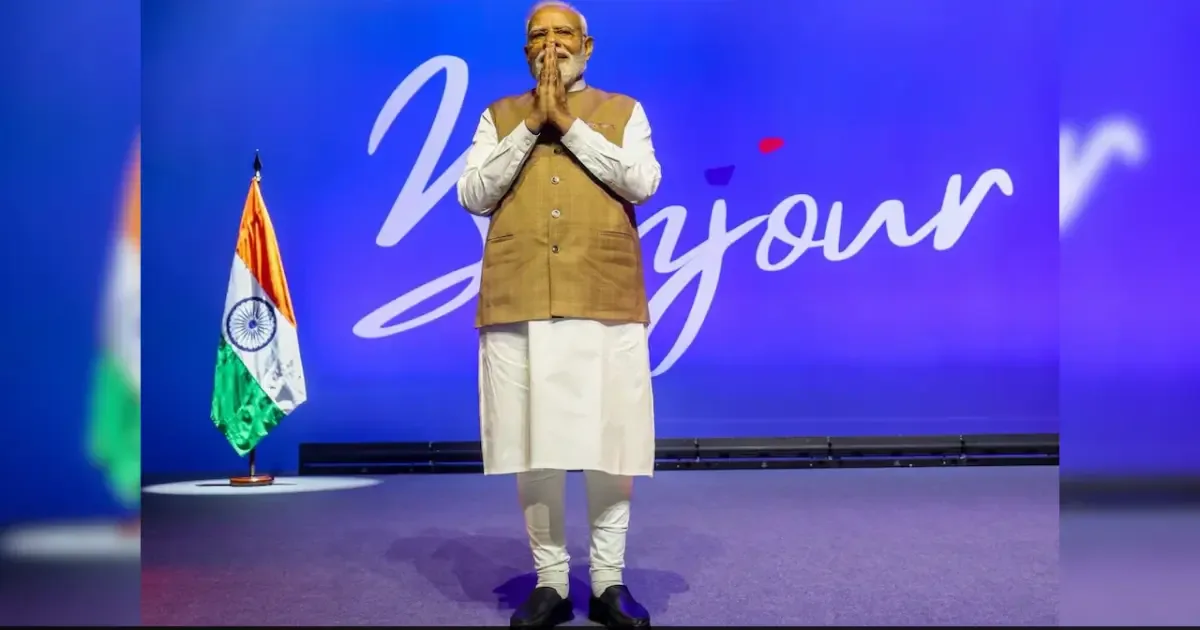
Prime Minister Narendra Modi addressed the Indian diaspora in Paris, making a significant announcement about India’s future in space exploration. He declared that India is actively preparing for the Gaganyaan human spaceflight mission and is committed to building its own space station. This pledge signifies India’s growing ambitions and its determination to shape its own destiny in space.
The crowd responded with enthusiastic applause, recognizing the profound implications of these announcements. Modi conveyed a message of confidence, presenting India’s next major leap in space as an inevitable reality. The dual announcements underscore a pivotal shift in global perceptions of India’s space capabilities.
While a specific timeline for the space station was not provided, Modi emphasized that work is already in progress, stating, “The day is not far.” The choice of Paris for this announcement, during a visit to France, highlighted its importance as a global message and a “pledge for the future” to the Indian community worldwide.
Modi connected these space endeavors to India’s broader development journey, stating, “Our aspirations and our determination are driving the country’s development journey.” His personal engagement with the topic resonated deeply with the audience.
Gaganyaan: India’s Historic Human Spaceflight Mission
The Gaganyaan mission, a familiar term to followers of India’s space program, gained renewed significance with Modi’s Paris announcement. This mission represents India’s first human spaceflight endeavor, aiming to send Indian astronauts, sometimes referred to as “vyomanauts,” into low-Earth orbit.
The mission’s objective is for the crew to spend up to seven days in space, conducting scientific experiments and testing crucial technologies. The Indian Space Research Organisation (ISRO) has been diligently developing the necessary components, including a crew module, life support systems, and a human-rated launch vehicle.
Modi’s statement in Paris signals the government’s high priority for Gaganyaan, emphasizing commitment over technical specifics. The use of the present tense, “We are preparing for Gaganyaan,” indicates that the mission is an active, ongoing project rather than a distant plan.
Gaganyaan will mark a historic milestone as India will launch humans into space on its own rocket for the first time. This achievement will place India among a select group of nations, including the United States, Russia, and China, capable of independent human spaceflight.
Vision for India’s Own Space Station
The announcement of India building its own space station is a significantly ambitious goal, surpassing that of a single human spaceflight mission. A space station is a permanent orbital facility designed for long-term human habitation and research.
Modi explicitly linked the Gaganyaan mission to this larger vision, stating, “The country is building its own space station.” This endeavor positions India alongside the United States, Russia, and China, which have operated their own space stations.
While details regarding the station’s design and completion date were not disclosed, the message was clear: India is transitioning from a consumer of space services to a builder of space infrastructure. The Indian space station is expected to be modular, launched in sections, and assembled in orbit.
This station will serve as a vital platform for microgravity research, testing technologies for extended missions, and gaining experience in supporting human life in space for prolonged durations. It represents a significant step for national pride, scientific independence, and advanced space research.
Call for Deep Space Exploration
Prime Minister Modi extended India’s space ambitions beyond Earth’s orbit, urging scientists to prepare for “deep space” exploration. He stated, “I call upon our scientists to prepare for the exploration of deep space. These unexplored areas hold vital secrets for the future of humanity.”
Deep space typically refers to regions beyond the Moon, including areas like Mars and the asteroid belt. Modi’s call suggests a forward-looking vision that encompasses human missions to these distant frontiers.
He framed this exploration not just as a matter of national prestige but as a pursuit of scientific discovery and a fulfillment of humanity’s innate curiosity. India’s past successes, such as the Mars Orbiter Mission, were robotic, but Modi’s call signals a desire for human-led exploration in the future.
India as a ‘Trusted Partner’ Globally
Modi’s address in Paris also highlighted India’s evolving role on the global stage, describing the nation as “emerging as a trusted partner to the world.” This designation emphasizes India’s willingness to collaborate and contribute internationally.
In the context of space, this implies a readiness for international cooperation, sharing technology, and data. The potential Indian space station could serve as a hub for global collaboration, welcoming experiments and astronauts from other nations.
The timing of the announcement in Paris is significant, given France’s standing as a major space power and its existing cooperative relationship with India. This strategic location underscores India’s view of Europe as a key partner in its space ambitions.
Modi reiterated, “We are not merely preparing for the future. We are actively shaping it,” signaling India’s proactive approach to establishing its presence and influence in space exploration.
Roadmap and Future Steps
While specific timelines were not detailed, the path forward for India’s space program is becoming clearer. The Gaganyaan mission is the immediate priority, with ISRO having completed significant testing for its crew module and launch vehicle systems. An uncrewed test flight is anticipated soon, serving as a critical precursor.
The human-rated LVM3 launch vehicle is undergoing modifications for crewed flights, building on its proven success in satellite launches. If these stages proceed as planned, India could see its first astronauts launch within the next few years, laying the groundwork for future endeavors.
The space station represents a longer-term project, requiring the launch and assembly of multiple modules. India’s approach is likely to be incremental, starting with a core module and expanding over time, similar to the development of China’s Tiangong station.
The progression from Gaganyaan to extended human presence in orbit, culminating in a permanent station, is a strategic roadmap. Modi’s announcement signifies governmental commitment and readiness to fund these ambitious steps.
Diaspora’s Response and National Pride
The Indian diaspora in Paris reacted with immense pride and enthusiasm to the space announcements. The applause for the mention of a “space station” underscored the symbolic importance of these achievements for the community.
For many expatriate professionals, these developments represent tangible proof of India’s progress and its growing global stature. Modi’s words, “Our aspirations and determination are driving the country’s development journey,” served as a direct acknowledgment of their connection to India’s success.
India’s space program, marked by missions to the Moon and Mars, has long been a source of national pride. The prospect of sending humans to space and establishing an orbital habitat adds a new dimension to this pride, showcasing India’s advanced capabilities.
Modi’s speech in Paris was not just about policy but also about national identity, signaling India’s readiness for a new era of achievement and its determination to make its mark on the global stage. The sentiment, “The day is not far,” resonated with the audience’s eagerness for India’s future in space.
Frequently Asked Questions
What is the Gaganyaan mission?
The Gaganyaan mission is India's first human spaceflight program, aiming to send Indian astronauts into low-Earth orbit for up to seven days. It involves developing a crew module, life support systems, and a human-rated launch vehicle.
When will India launch its own astronauts?
While no specific date was given, Prime Minister Modi indicated that the day is not far. The Gaganyaan mission is expected to launch within the next few years, following successful test flights.
What are the plans for an Indian space station?
India plans to build its own space station, which will serve as a platform for microgravity research and long-term human habitation in orbit. It is expected to be built in modules and assembled in space.
Which nations have launched their own astronauts before?
Only a few nations have independently launched humans into space, including the United States, Russia, and China. India aims to join this exclusive group with the Gaganyaan mission.
What does "deep space exploration" mean in this context?
Deep space exploration refers to missions beyond the Moon, potentially including destinations like Mars and the asteroid belt. Prime Minister Modi has called on scientists to prepare for these more distant and challenging frontiers.
Why did PM Modi announce these plans in Paris?
Prime Minister Modi chose to make these significant announcements during a visit to France, addressing the Indian diaspora. This strategic choice aimed to convey India's ambitions on a global stage and highlight its growing international partnerships, particularly with European space powers.
References
- "Country Preparing For Gaganyaan, Building Its Own Space Station": PM Modi – Original report (NDTV India)
- "Country Preparing For Gaganyaan, Building Its Own Space Station": PM Modi – NDTV – NDTV reported the prime minister's direct quote announcing both the Gaganyaan preparation and the space station plan.
- India emerging as ‘trusted partner’ to the world: PM Modi – ThePrint – ThePrint highlighted Modi's framing of India as a 'trusted partner' globally, giving broader diplomatic context to the space announcements.
- ‘India not merely preparing for future, it is actively shaping it,’ PM Modi tells diaspora in Paris – WION – WION captured Modi's future-oriented rhetoric that India is actively shaping events, not just reacting to them.
- PM Modi calls upon scientists to prepare for exploration of deep space as these unexplored areas hold vital secrets for future of humanity | Akashvani News – Newsonair – Newsonair provided a unique angle: Modi specifically urged scientists to focus on deep space exploration for humanity's future benefit.
- 'The day is not far': PM Modi sets big space ambition, says India will soon have its own space station – The Times of India – The Times of India emphasized the prime minister's confidence with the phrase 'the day is not far,' projecting a near-term timeline for the space station.